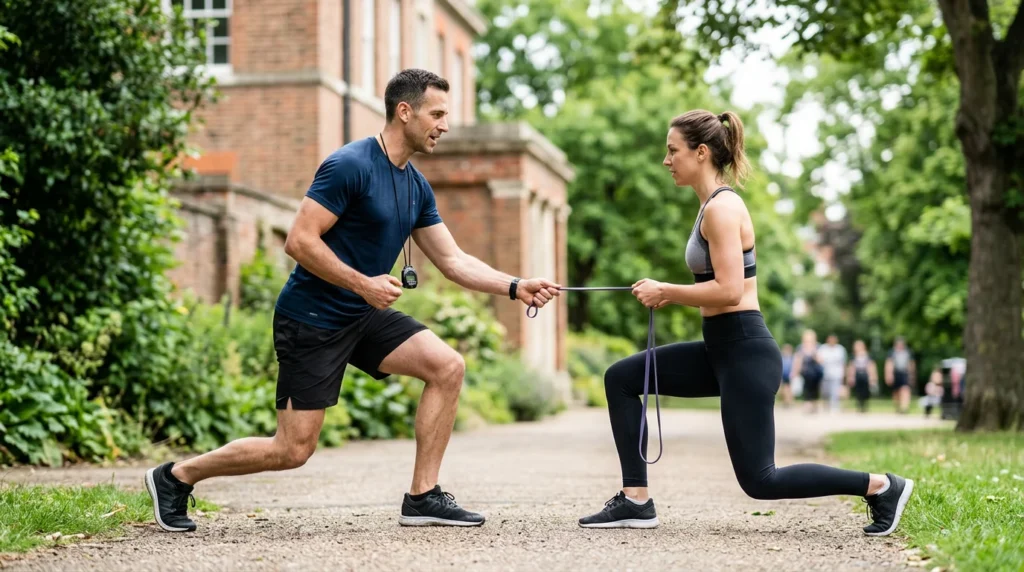
Quick answer: Choose a personal trainer who matches your main goal and can show you, in the first session, how they coach form: clear cues, sensible regressions, and a stop/modify rule if pain appears. Pick someone who tracks sessions (sets, reps, loads, notes) and explains a 4–6 week progression. Confirm the training location, travel time, and session times fit your Stoke Newington routine.
What To Look For In Your First Conversation
A good first chat should feel like a quick needs analysis, not a pitch. You should be asked about your goal, training history, current activity, injury history, sleep, work stress, and what you can realistically commit to each week. You should hear a simple plan: what you’ll do in sessions, what you’ll do between sessions, and how progress will be measured.
Look for testable coaching behaviors. They should describe how they’ll teach technique (1–2 cues at a time, a demo, then feedback), how they’ll regress an exercise (for example, goblet squat before barbell back squat, incline press before flat bench), and what their pain rule is (sharp pain stops the set; they change range of motion, load, or exercise). Ask what they record after each session—at minimum weights, reps, and a brief note like “RPE 7/10” or “knee felt fine at this depth.”
If you’re searching for a personal trainer Stoke Newington, ask where sessions actually happen (gym, park, or home), what equipment is available, and how they handle bad weather or busy peak times. Clear answers now save frustration later.
Stoke Newington Practicalities That Affect Results
Convenience decides consistency. In Stoke Newington, pick a setup that you can reach reliably: a local gym within a short walk or bus ride, a nearby park session if you like outdoor training, or home visits if travel time is your biggest barrier. Set a hard travel boundary (for many people, 10–20 minutes each way is a realistic ceiling) so sessions don’t get skipped when life gets busy.
Match session times to your commute pattern. If you travel into central London, early morning slots can be easier to protect than evenings that get eaten by delays and social plans. If you work locally or from home, a lunchtime session can be a consistent anchor. Ask how flexible rescheduling is, and whether they can offer a regular weekly slot rather than changing times every week.
Also check the training environment: if it’s a gym, ask whether it gets crowded at the times you can train and how they adapt when equipment is taken. If it’s a park, ask what they do when it’s wet or dark—do they switch to a sheltered spot, bring appropriate equipment, or move the session indoors?
First-Session Checklist And What A 4–6 Week Plan Can Look Like
A solid first session usually includes three pieces: (1) a quick movement check, (2) baseline testing, and (3) a starter program you can repeat. Movement checks don’t need to be fancy—common basics are a bodyweight squat, hip hinge pattern (like a dowel hip hinge), a lunge or step-up, an overhead reach/shoulder check, and a simple core brace (dead bug or plank). You’re looking for coaching that spots limitations and adjusts on the spot.
Baseline testing should be safe and relevant. Strength baselines might be a submax set (for example, a weight you can lift for 6–10 controlled reps) on a squat pattern, a hinge pattern, a press, and a row. Conditioning baselines can be low-risk: a timed brisk walk, a short interval on a bike/rower, or a simple step test—something repeatable, not a suffer-fest.
A sensible 4–6 week progression often looks like: weeks 1–2 build technique and tolerance (moderate loads, consistent exercises); weeks 3–4 add small increases (a bit more weight, one extra set, or a rep or two); weeks 5–6 either repeat with slightly higher targets or rotate one or two exercises while keeping the main patterns. You should hear how they decide progressions (for example: “If all sets hit the rep target with good form and you rate effort around 7–8/10, we add a small amount next time”).
Questions To Ask And Examples Of Good Vs Bad Answers
“How many sessions per week should I do?” Good answer: “Let’s start with 1–2 sessions weekly plus 1 simple workout you can do alone; after two weeks we’ll review your recovery and schedule.” Bad answer: “You need 5 days a week or it won’t work,” with no discussion of your time or recovery.
“How do you adjust training if I have knee/back/shoulder issues?” Good answer: “We’ll identify which movements aggravate it, keep pain below a mild level, and swap to a regression—like box squats, split squats with a shorter range, or hip hinges with lighter loads—while we build capacity.” Bad answer: “Pain is weakness leaving the body,” or pushing through sharp pain.
“How do you decide when to add weight or change exercises?” Good answer: “We track reps, load, and effort; if form stays consistent and effort is in range, we progress gradually. If form breaks, we hold or regress.” Bad answer: “I just go by vibes,” or changing the whole workout every session with no repeatable measures. If you want to speak to a trainer, ask for a consult and compare their answers to the questions above; KBPT Personal Training East London is one local option to contact.