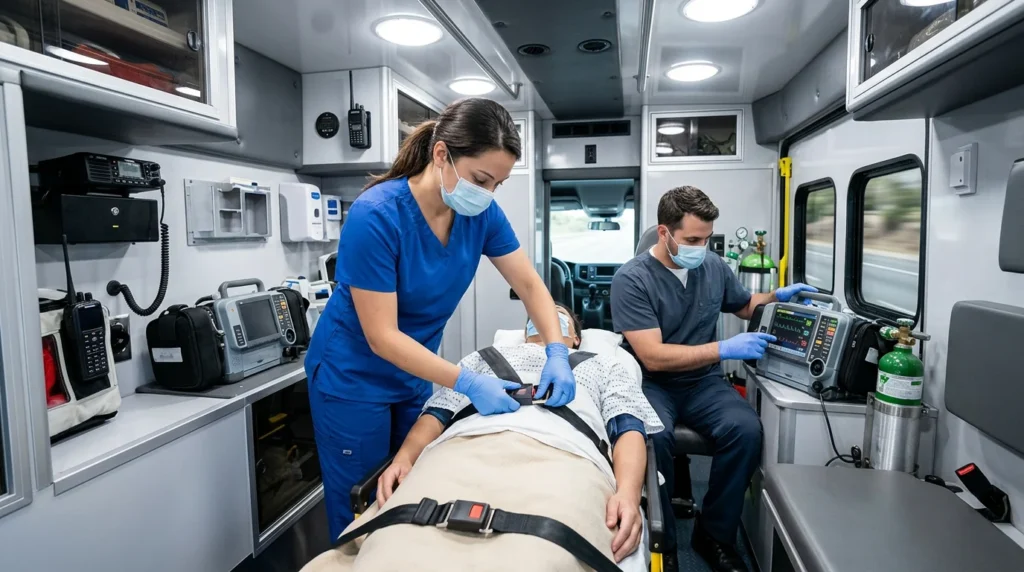
Quick answer: A safe long-distance medical transport provider should screen the patient’s needs in advance, match the right vehicle and crew, verify equipment and medications, and use consistent infection-control practices. During the trip, they should monitor the patient, document changes, manage oxygen and power safely, and have clear escalation plans for emergencies. After arrival, they should complete a structured handoff and sanitize the vehicle.
What “Safety Protocols” Means in Long-Distance Transport
In long-distance medical transport, safety protocols are the repeatable steps that prevent predictable problems: medical decline during transit, equipment failures, falls during loading, infections, and miscommunication at pickup or drop-off. Good protocols start before anyone rolls a stretcher—by confirming the patient’s condition, mobility, oxygen needs, medication schedule, allergies, and any special risks like aspiration or confusion.
Look for providers that can explain their medical transport safety protocols in plain language and show you what they use in practice: a sample pre-trip checklist, an equipment list for your patient’s level of care, a written escalation plan (who they call and when), and an infection-control cleaning log. If the company can’t share documents or describe these steps clearly, that’s a practical warning sign.
Crew credentials, monitoring, and medication handling vary with patient acuity and state/local regulations. Confirm the provider’s licensure and the promised level of care in writing, including what monitoring will be used and who is authorized to administer or assist with medications during transport.
Core Protocols Before Pickup
Ask for a written checklist (or read-back of it) and treat these as pass/fail items before you agree to the trip:
- Patient fit: Written confirmation of the patient’s diagnosis-related risks, mobility status, cognitive status, isolation needs, and baseline vitals/oxygen requirement (or a statement of what will be monitored).
- Level of care: In writing, the crew type assigned (for example, ambulance-level vs. medical escort) and what that crew can legally do under the applicable state rules.
- Oxygen duration: A documented oxygen calculation for the full trip time plus a reserve (for example, an added buffer for delays), including cylinder size/pressure or concentrator plan.
- Power plan: Documented battery runtime for any device (monitor, suction, concentrator) plus a backup battery/charger plan and where charging will occur.
- Restraints and locks: Visual inspection of stretcher locking, belts, shoulder straps (if used), and any wheelchair tie-downs; no frayed webbing, no broken buckles, positive lock engagement.
- Equipment readiness: A dated equipment list showing required items for the patient (for example, suction if aspiration risk is identified) and confirmation that supplies are present and functional.
- Medication plan: A written plan for medication timing during transit and who will handle it, consistent with the patient’s orders and what the crew is allowed to do.
- Route/logistics: Confirmed pickup and drop-off contacts, stair/elevator details, transfer method, and a plan for rest stops that won’t compromise safety or privacy.
- Escalation plan: A written “what-if” plan for deterioration (who is contacted, when 911 is called, and how the nearest appropriate facility is selected).
- Infection control: Documentation of cleaning between patients and the PPE approach for the patient’s situation (for example, respiratory symptoms or isolation precautions).
Safety Practices During the Trip
During transit, safety is a mix of clinical monitoring and “road” safety. The crew should reassess the patient after loading—positioning, skin protection, warmth, pain control plan, and securement of tubing so it can’t pull. Ask what they document at set intervals (for example, symptoms and any vitals they are monitoring) and whether you can receive a copy of the trip record after arrival.
For patients on oxygen, the team should manage flow settings carefully, keep cylinders secured upright, and watch for kinks or leaks. If a patient uses a concentrator, ask for the written power and backup plan. Long rides also create risks like dehydration, pressure injuries, and agitation, so request the planned comfort-check schedule and repositioning approach when appropriate.
If the patient’s condition worsens, the crew should follow the written escalation plan rather than improvising. Credentials, monitoring frequency, and what interventions are allowed depend on patient acuity and state/local regulations, so verify in advance what the assigned crew can do and what triggers a higher level response.
Standards to Align With
Families often feel better when a provider’s procedures map to well-known guidance. These references are general guardrails, not company-specific policy, and they don’t replace medical orders or local rules.
For infection prevention during patient movement and vehicle cleaning, compare the provider’s process to CDC infection-control guidance (including PPE use and environmental cleaning concepts). For who can provide what level of care, look to your state’s EMS/ambulance regulations and licensing rules, which typically define vehicle requirements, staffing levels, and scope of practice. For vehicle and equipment securement, ask how their stretcher, wheelchair tie-downs, and cargo restraint practices align with DOT/FMCSA-style securement principles and manufacturer instructions.
Ask the provider to point to the specific state license they operate under and to put the promised level of care, staffing, and monitoring in writing for your trip.
Questions to Ask Before You Book
Ask a few direct questions and listen for specific, verifiable answers: Can you send a sample pre-trip checklist and the equipment list for this patient’s level of care? What monitoring will you use during transport, and can you show a sample trip record? Can you provide the written escalation plan and explain exactly when you would stop, divert to a facility, or call 911?
Also ask about medication handling and infection control in concrete terms: Who is authorized to assist with medications, and how will dosing times be tracked? Can you provide a recent cleaning log template and describe what gets disinfected between patients? These details vary by patient acuity and state/local regulations, so confirm licensure and level of care in writing before you schedule.
If you want help arranging long-distance transport with clear expectations around safety and communication, contact Managed Medical Transport, Inc.